

Picture this: it’s the first game of the season. Your team runs onto the oval looking sharp, confident, and united. The opposition takes one look at your gear and already feels the pressure. That’s the power of a well-chosen football uniform — it’s not just clothing, it’s a statement.
But picking the right custom uniform isn’t as simple as choosing a colour and calling it done. Get it wrong and you’re looking at ill-fitting jerseys, faded numbers after three washes, and a kit that’s falling apart by the finals. Get it right, and your team looks — and feels — like they mean business for seasons to come.
Whether you’re kitting out an AFL club, a rugby team, or a touch football squad, this guide walks you through every decision that matters. Let’s get into it.
1. Start With the Sport — Because Not All Football is the Same
This might sound obvious, but it’s where a lot of clubs go wrong. ‘Football’ means different things across Australia, and the uniform requirements vary significantly between codes.
AFL uniforms are designed for speed and agility. They’re typically sleeveless with a close body fit, built to handle hard collisions without restricting movement. The fabric needs to be breathable and tough enough to survive regular sliding tackles on grass.
Rugby union and rugby league jerseys are a different beast entirely. They need reinforced seams, a looser upper body cut, and fabric that doesn’t tear when a prop grabs your collar in the breakdown. Collars matter here too — most rugby jerseys feature a solid buttoned or v-neck collar for that reason.
Touch football sits somewhere in the middle — lighter fabric, shorter shorts, and more emphasis on comfort and ventilation since it’s a non-contact game often played in warm conditions.
Know your code before you start. It shapes every other decision that follows.
2. Fabric First — What You Choose Affects Everything
The fabric is the foundation of any great football uniform. It determines how your players feel during a game, how the kit holds up over a season, and how your club’s colours look on match day.
Here’s what to look for:
- Polyester: The gold standard for sportswear. Lightweight, moisture-wicking, and colourfast. Holds sublimated prints beautifully and doesn’t shrink. Most custom football uniforms use 100% polyester or a polyester blend.
- Recycled polyester: Increasingly popular with clubs that care about sustainability. Same performance as virgin polyester but made from recycled plastic — a great talking point for sponsors too.
- Spandex/Lycra blends: Often added (typically 5–15%) for stretch and recovery, especially useful in AFL cuts where freedom of movement is critical.
- Avoid cotton: It absorbs sweat rather than wicking it away, gets heavy when wet, and fades faster. Fine for training tees, not for match-day uniforms.
Don’t just ask for ‘good quality fabric.’ Ask for the gsm (grams per square metre). A match-day jersey typically sits between 140–180gsm. Too light and it feels cheap and tears easily. Too heavy and it restricts movement and overheats your players.
3. The Fit Question: One Size Does NOT Fit All
A uniform that doesn’t fit right isn’t just uncomfortable — it looks unprofessional and affects how players move on the field. This is one of the most common complaints clubs have after receiving their gear.
When thinking about fit, consider:
- Sizing range: Does the supplier offer XS through to 4XL or beyond? Football teams include all body types, and everyone deserves a uniform that fits properly — not a shirt they’re squeezing into or drowning in.
- Gender-specific cuts: Women’s AFL and netball-adjacent football codes have seen massive growth. If your club has female players, make sure the supplier offers properly tailored women’s cuts, not just smaller versions of the men’s jersey.
- Youth sizes: Junior clubs and school teams need proper youth sizing. Children’s bodies aren’t proportioned the same as adults, so scaled-down adult patterns won’t cut it.
- Custom sizing: Some suppliers can accommodate custom measurements for players who fall outside standard sizing. Worth asking, especially for larger clubs with diverse body types.
Always order a sample or size set before your full run. Have a few players try them on — ideally someone on the smaller end and someone on the larger end of your squad. If it doesn’t look right on them, it won’t look right in the photos either.
4. Printing Methods: Why Sublimation Wins for Custom Footy Gear
You’ve got your fabric sorted and your sizing locked in. Now comes the fun part — the design. But before you start sending through your club’s crest and colour palette, you need to understand how that design is actually going to get onto the jersey.
There are two main methods used for custom football uniforms:
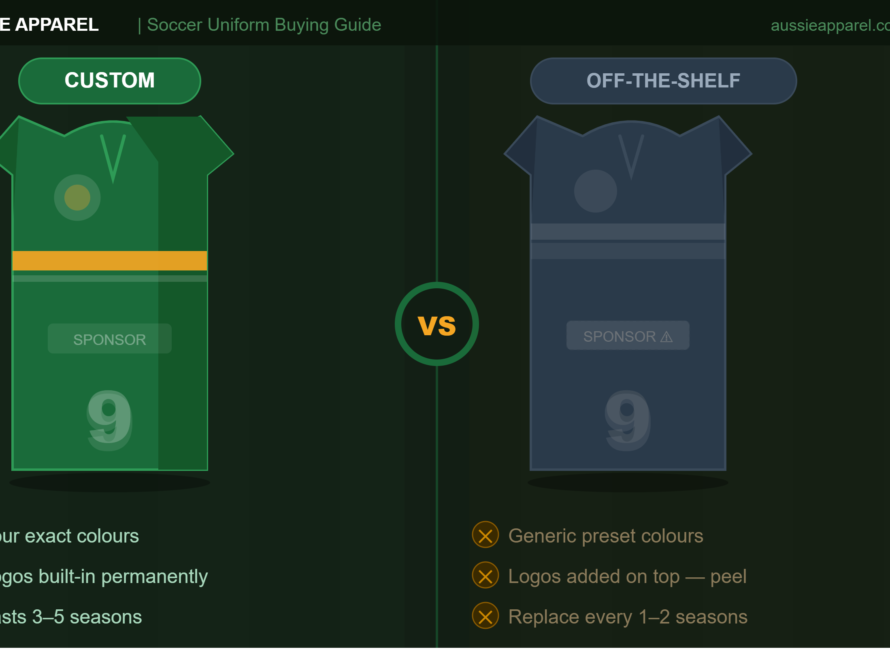
Screen Printing applies ink layers on top of the fabric. It works well for simple, bold designs with limited colours. The downside? The ink sits on top of the material, which means it can crack, peel, or fade — especially with regular washing and hard use. It also limits how complex your design can be.
Sublimation Printing is the better choice for custom sportswear. The dye is infused directly into the fabric fibres using heat, meaning it becomes part of the material rather than sitting on top of it. The result is a print that won’t peel, crack, or fade — even after hundreds of washes. And because it works with any colour combination and level of detail, your design options are virtually unlimited.
With sublimation, you can have gradients, photographic textures, full-coverage patterns, and pinpoint-accurate colour matching. It’s how professional clubs get their gear looking so sharp — and it’s now accessible to community clubs and school teams too.
5. Design: Getting Your Club’s Identity Right
A great football uniform tells people who you are before the whistle blows. It carries your club’s history, your colours, your identity. So while it might be tempting to throw together a design over a weekend, it’s worth spending some real time on this.
Here are the design decisions you’ll need to make:
- Primary colours: These should match your club’s existing brand. If you don’t have a formal colour code, work with your supplier to lock in Pantone or CMYK values so your colours are consistent across all your gear.
- Numbering: Back numbers are usually required for competition. Some codes also require front numbers or player names. Decide early — they need to be factored into the design template.
- Sponsor logos: If you have club sponsors, you’ll need to know their logo sizes and placement requirements before finalising the design. Most sponsors will provide a vector file (AI or EPS format) — always use vector, never a JPG or PNG pulled off a website.
- Club crest or badge: This should also be provided as a high-resolution vector file. If your club’s crest is old or low-quality, now is a good time to get it properly digitised.
- Naming on jerseys: Some clubs personalise jerseys with player names above the number. It adds a nice touch, especially for school leavers or milestone seasons.
A good custom apparel supplier will have an in-house design team (or at least a designer) who can help you turn your ideas into a production-ready file. Don’t be afraid to ask for multiple mockups before you approve anything. Once production starts, changes are expensive.
6. Turnaround Time: Plan Ahead or Wear Last Year’s Kit
This is the part most clubs underestimate. Custom uniforms take time — and rushing the process almost always leads to mistakes, compromises, or late deliveries that leave your players wearing mismatched gear for round one.
Here’s a realistic timeline to work backwards from:
- 8–12 weeks before the season: Start conversations with suppliers. Get quotes, discuss fabrics and designs.
- 6–8 weeks before the season: Finalise your design and place your order. This is your production lead time.
- 2–4 weeks before the season: Delivery, distribution, and time to fix any sizing issues or errors before the first game.
If your season starts in March, you should ideally be placing your order by late November or early December. Yes, that early. Production slots fill up, especially heading into the warmer months when orders peak.
Also factor in: if a jersey arrives and three players need a size swap, you need time to sort that out without missing round one.
7. Minimum Order Quantities and Budget: What’s Actually Realistic
Custom uniforms aren’t a per-item purchase like buying off the rack. Most suppliers work with minimum order quantities (MOQs), and understanding this upfront saves you the awkward conversation later.
MOQs typically range from 10 to 20 pieces per design for sublimated uniforms. This covers the setup costs for cutting patterns and setting up the printing process. Some suppliers will go lower, but often with a price premium.
On budget: custom sublimated football jerseys generally range from $40 to $90 per jersey depending on complexity, quantity, and supplier. Shorts add another $25 to $50. Socks, training bibs, and bags can be bundled in if you’re ordering a full kit.
A few ways to make the budget work:
- Sponsor contributions: Many local businesses are happy to sponsor a jersey or shorts in exchange for logo placement. A $500 sponsorship from a local tradie or café goes a long way toward the uniform cost.
- Player levies: Spreading the cost across the squad as part of a small annual levy makes it manageable for most clubs.
- Phased ordering: Some clubs order match jerseys in year one, then add training gear and playing shorts in year two as the budget allows.
8. Choosing the Right Supplier: Questions Worth Asking
Not all custom apparel suppliers are created equal. Some are resellers with long offshore supply chains and little quality control. Others, like Aussie Apparel, are manufacturers with direct oversight of production, which means faster turnaround, better quality control, and a team that actually understands what Australian football clubs need.
Before you commit, ask:
- Can I see samples of previous work? Any reputable supplier should be happy to show you finished uniforms they’ve made for other clubs.
- What’s your production lead time? Get this in writing, not just as a verbal estimate.
- Do you offer size exchanges post-delivery? Things go wrong — a player measure-up gets missed, or someone joins the squad after the order goes in. Know the policy upfront.
- Where is the gear made? Locally manufactured uniforms generally have shorter lead times, better communication, and easier problem resolution.
- Can you handle my entire kit? If you can get jerseys, shorts, socks, and training gear from a single supplier, do it. It simplifies everything and usually gets you a better price.
Final Whistle
Choosing the right custom football uniform is one of the best investments a club can make — and one of the most visible. Done well, it lifts team culture, impresses sponsors, and gives your players something to be genuinely proud of pulling on every week.
Done poorly, you’re stuck with jerseys that don’t fit, colours that faded after five washes, and a design you can’t wait to replace.
Take your time, ask the right questions, and work with a supplier who knows their stuff. Your players will thank you for it when they run out onto the field looking like a team that means business.