

Netball is one of Australia’s most widely played sports. With over 1.2 million registered players and hundreds of thousands more competing in social competitions, school carnivals, and representative programs, the demand for well-designed, high-performing netball uniforms has never been higher.
And yet, walk into almost any club’s changeroom and you’ll hear the same complaints: the dresses don’t fit properly, the colours aren’t quite right, the fabric bunches under the arms, the numbers are peeling, and whoever ordered them two seasons ago is getting the blame.
This guide exists to fix that. Whether you’re a club coordinator ordering for the first time, a coach refreshing an aging kit, or a school sports coordinator trying to do right by your players, this is the most practical, honest guide to netball uniform design you’ll find.
We’ll cover what Australian teams are actually wearing right now, which design elements work and which ones look dated, what fabrics perform best on court, and what questions to ask before you spend your club’s money.
1. The State of Netball Uniforms in Australia Right Now
Australian netball has undergone a genuine visual evolution over the past five to seven years. The old days of simple block-colour dresses with iron-on numbers are well behind the top end of the sport — and those trends are now filtering down into community and school competitions.
Here’s what’s driving the shift:
- The Diamonds and Super Netball effect: Australia’s elite teams have raised the visual bar significantly. Full-sublimation kits with detailed geometric patterning, gradient colourways, and precise sponsor integration have become the benchmark. Players at every level have seen this look and want it for their own club.
- The rise of women-specific design: For a long time, netball uniforms were designed around a generic fit. That’s changing. Properly engineered women’s cuts — with adjusted shoulder width, a shaped waist, and appropriate hemlines — have become the expectation rather than the exception.
- Social media visibility: Teams post match-day photos, team shots, and highlight reels constantly. Clubs are increasingly aware that their uniform is a visible representation of their identity far beyond the court. A sharp-looking kit generates genuine pride and community engagement.
- Longer kit cycles: Clubs that invest in quality sublimated uniforms are finding they last three to five seasons without significant deterioration. That changes the economics — spending more upfront starts to make obvious sense when the kit doesn’t need replacing every year.
2. Dress vs. Two-Piece: Which Format Is Right for Your Team?
This is often the first decision a club needs to make, and it’s worth thinking through properly because it affects everything from sizing to player comfort to design options.
The traditional netball dress (a combined bodice and skirt in one piece) remains popular, particularly at school and junior competition level. It’s simple, looks clean, and eliminates any risk of the top and skirt separating during play.
The two-piece format — a fitted crop or tank top paired with a separate skirt or skort — has been growing steadily, particularly in senior and representative competitions. Here’s why:
- Better individual sizing: Players can choose different sizes for the top and skirt based on their body proportions. This is a significant practical advantage — one player might need a size 10 top and a size 14 skirt, which a one-piece dress simply can’t accommodate.
- Easier to replace individual pieces: If a top gets damaged or a new player joins mid-season with a different skirt size, you’re replacing one item rather than a full dress.
- More design flexibility: Two-piece sets allow for contrasting colours between the top and skirt, more complex design placement, and a slightly more contemporary look overall.
- Personal preference: Some players simply find two-piece sets more comfortable for movement. Others prefer the security of a dress. Asking your squad before deciding is always worth doing.
At the junior and school level, dresses remain practical and popular. For senior clubs and representative teams, two-piece sets are increasingly the preferred choice. If you’re unsure, ask your players — they’ll have a strong view.
3. Design Trends: What Australian Netball Teams Are Actually Wearing
Fashion cycles through every sport, and netball is no different. Here’s an honest look at what’s trending right now in Australian netball uniform design — and what’s starting to look a bit tired.
What’s on trend:
Geometric side panels
Angular panelling down the sides of the bodice and skirt — triangles, chevrons, diagonal splits — creates visual interest and a modern athletic look without overwhelming the main club colours. This is probably the most common design element in current Australian netball kits.
Tonal designs
Using varying shades of the same primary colour rather than high-contrast combinations. A deep navy base with mid-blue panels and light blue accents creates a sophisticated, layered look that photographs well and doesn’t date quickly.
Subtle texture and pattern
Sublimation allows for background textures — fine mesh patterns, geometric microprint, abstract shapes — that add visual depth without making the uniform look busy. Applied at low opacity behind the primary design, these elements elevate a kit from flat to polished.
Bold contrasting trim
A strong contrasting colour used for collar trim, hem lines, and sleeve edges ties the design together cleanly. White trim on a dark uniform, or a gold or orange accent on a green or navy kit, creates definition and sharpness.
Clean logo placement
The club crest sits centred on the chest, sponsors go on the skirt front or across the upper back. Clean hierarchy in logo placement makes a uniform look considered rather than cluttered.
What’s fading out:
All-over loud prints
Busy full-coverage patterns without clear design logic look chaotic and date quickly. Effective full-coverage designs use restraint — one dominant element, supported by secondary elements, not competing with them.
Multiple mismatched fonts
Clubs occasionally add player names, squad numbers, and competition branding in different typefaces. Pick one clean sans-serif and use it consistently across everything.
Neon colour combinations
The early 2010s neon trend has run its course. Clubs that invested in neon green and hot pink kits a decade ago are the ones most eager to upgrade. Saturated but not fluorescent is where most teams are landing.
4. Fabric and Performance: What Actually Matters on Court
Netball is a stop-start, high-intensity sport. Players are sprinting, landing, pivoting, reaching, and defending continuously across four quarters that can stretch to an hour or more of active play. The fabric your uniform is made from has a direct impact on how players feel and perform.
Here’s what to look for:
- Moisture-wicking polyester: This is the baseline requirement. Polyester draws sweat away from the skin and disperses it across the fabric surface where it can evaporate. Cotton absorbs moisture and holds it — exactly the wrong behaviour for a sport played at high intensity.
- Four-way stretch: A fabric that stretches horizontally and vertically with recovery — meaning it returns to its original shape — allows full freedom of movement without the dress riding up, bunching, or pulling across the shoulders. Look for a polyester-spandex blend (typically 90% polyester, 10% spandex) for the best combination of stretch and durability.
- gsm (grams per square metre): For netball dresses, 140–160gsm is the sweet spot. Light enough to stay cool and allow movement, substantial enough to feel quality and hold the print well. Below 130gsm starts to feel cheap; above 175gsm gets heavy and restricts movement.
- Breathability: The fabric needs to allow air circulation. Tightly woven fabrics with dense prints can trap heat. A quality sublimated polyester mesh or open-weave construction handles this well — the ink bonds into the fibres without blocking air flow.
- Anti-static properties: Polyester can build up static charge, which causes dresses to cling. Better-quality fabrics include anti-static treatments. Worth asking about, particularly for synthetic courts and indoor venues.
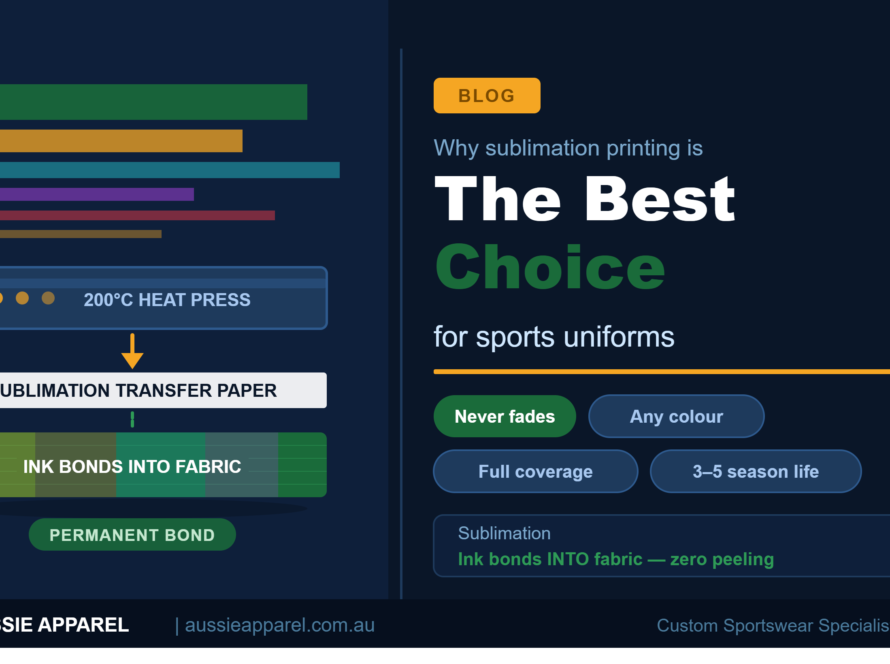
One thing worth noting: sublimation printing doesn’t affect any of these performance properties. Because the dye bonds into the fibre rather than coating the surface, the fabric’s breathability, stretch, and moisture management are completely unchanged by even the most detailed print.
5. Getting the Sizing Right — The Biggest Source of Uniform Headaches
Ask any club coordinator what caused the most stress after their last uniform order and sizing will come up in nine out of ten conversations. Someone’s dress is too tight across the shoulders. Someone else’s skirt hem hits at an unflattering height. Three players need a size exchange and the supplier has a four-week turnaround.
Here’s how to avoid all of that:
- Use a size set, not just a size guide: A printed size guide tells you measurements. An actual sample size set — physical garments in each size — lets players try them on. Many suppliers will send a size set on request. The cost of a courier both ways is trivial compared to the cost and frustration of a batch of wrong-sized uniforms.
- Measure players properly: Height and weight alone aren’t enough. For netball dresses, you need chest, waist, hip, and torso length (nape of neck to natural waist). For two-piece sets, measure chest and waist for the top; waist and hip for the skirt. Create a simple measurement form and collect data from every player before placing the order.
- Build in a 10% buffer for new members: Player rosters change. Someone joins after the initial order, someone’s daughter wants to play. Order two or three extra uniforms in the most common sizes and keep them in reserve. It’s far cheaper than a rush reorder.
- Check the skirt length options: Netball skirts come in several standard hem lengths — mini, short, and mid-thigh. Different players and different age groups have strong preferences. Confirm with your squad before specifying a length, and check whether your competition has any rules about minimum hem length for junior players.
- Women’s sizing is not universal: Different suppliers use different block patterns for women’s sizing. A size 12 from one brand is not the same as a size 12 from another. Always size off the actual measurements, not off previous uniform sizes from a different supplier.
6. Colours, Club Identity, and Getting Your Brand Right
Your club colours are your identity. They’re what players wear with pride, what parents recognise on the far court, and what your team has built years of association and memory around. Getting the colour reproduction right on your uniforms is more important — and more technical — than most clubs realise.
Here’s what to know:
- Use Pantone or CMYK values, not colour names: ‘Royal blue’ means different things to different people and different printers. If your club doesn’t already have formally specified colour values, now is the time to lock them in. Ask your supplier to provide a Pantone reference, or agree on a CMYK breakdown. This ensures your uniforms, your banners, your social media graphics, and your merchandise all match.
- Request a physical colour proof before production: Colours look different on a monitor versus on fabric. A quality supplier will provide a strike-off or physical sample showing your colours as they’ll appear on the actual fabric. Never approve a colour-sensitive order based on a PDF or screen proof alone.
- Understand how sublimation affects colour: Sublimation printing produces slightly different colour results on different fabric colours and fabric densities. White or very light-coloured fabric produces the most vibrant, accurate colours. On darker base fabrics, light colours may need adjustment. A good supplier will flag this and adjust the artwork accordingly.
- Secondary and accent colours: If your primary colour is strong — a deep green, a bold navy — choose accent and trim colours that complement rather than compete. White, gold, silver, and black are consistently the most versatile accent choices. If your club has a secondary colour, use it sparingly as trim rather than as a competing block.
🏆 New club starting fresh?
If you’re establishing a new club or rebranding an existing one, resist the temptation to rush the colour selection. Look at what other clubs in your competition are wearing — you want to be distinct, not easily confused with your opponents. Then choose a primary, a secondary, and a neutral trim colour, lock in the values, and use them consistently across everything from uniforms to social media to club signage.
7. Numbers, Names, and Competition Requirements
Before you finalise your uniform design, check the rules. Netball Australia and state bodies have specific requirements around number placement, size, and legibility, and getting this wrong can result in your players being unable to take the court.
The key requirements to check:
- Number size: Netball Australia requires playing numbers to be a minimum height — typically 150mm on the back and 75mm on the front. Check your specific competition rules, as some state competitions have their own requirements.
- Number placement: Back numbers are mandatory. Front numbers may or may not be required depending on your competition. Some social competitions don’t require front numbers at all.
- Colour contrast: Numbers must be clearly legible against the background of the dress. If your primary colour is dark, numbers should be in white or a light contrasting colour. If your dress is predominantly white or light, dark numbers are required.
- Player names: Not required by competition rules, but increasingly common at senior and representative level. Names above the back number add a personal touch and are particularly popular for finals series kits and representative squads.
- Position bibs: Separate position bibs (GS, GA, WA, C, WD, GD, GK) are still required for most competitions. Some clubs order matching bibs that coordinate with their uniform colourway rather than using generic bibs. A nice detail that elevates the overall look.
Most custom uniform suppliers, including Aussie Apparel, will flag any potential compliance issues when reviewing your design brief. But it’s always worth knowing the rules yourself before the conversation starts.
8. Sponsor Integration — Making It Look Intentional, Not Bolted On
A sponsor logo on a netball dress can look professionally integrated or like an afterthought depending on how it’s handled in the design process. The difference is planning.
The clubs that handle sponsor logos best treat them as design elements rather than additions. They allocate sponsor placement zones during the initial design phase — before the base design is finalised — so the logo sits naturally within the overall layout rather than being placed over an existing design element.
Common sponsor placement zones for netball uniforms:
- Front bodice: The prime real estate. Usually reserved for the major sponsor. Position below the club crest, centred on the chest or slightly lower. Keep the logo to a reasonable size — a sponsor logo that overwhelms the club crest looks wrong.
- Front skirt panel: Works well for secondary sponsors. The flat surface of the skirt front provides good visibility and doesn’t compete with the bodice design.
- Upper back: Below the player number. Good visibility when players are running away from the camera or standing at the post.
- Sleeve hem or strap edge: For tertiary sponsors or partner logos. Smaller placement, but still visible in close-up photography and video.
When collecting sponsor logos, always request vector files (AI or EPS format). A JPEG or PNG pulled from a website will produce a blurry, low-quality result on a sublimated print. If a sponsor can’t provide a vector file, ask them to contact their graphic designer or branding team — or let your supplier know and they can often recreate it from a high-resolution version.
9. The Ordering Process — A Realistic Timeline
One of the most consistent mistakes clubs make with uniform orders is leaving it too late. Here’s a realistic timeline that works backwards from your season start:
- 12 weeks out: Begin supplier conversations. Gather design inspiration, confirm your colour values, collect player measurements.
- 10 weeks out: Submit your design brief. A good supplier will provide initial mockups within five to seven business days.
- 8 weeks out: Finalise design and approve the production proof. This is when you confirm colours, number placement, sponsor logos, and sizing breakdown.
- 8–6 weeks out: Production. A standard run of sublimated netball uniforms takes three to four weeks in production.
- 5–4 weeks out: Delivery, distribution, size checks, and time to resolve any issues before the first game.
If you’re reading this with less than eight weeks until your season starts, you’re not necessarily out of options — but you’re in rush territory, which means less time to review proofs, less flexibility on sizing changes, and potentially higher costs for expedited production. Start earlier next year.
10. What to Look for in a Netball Uniform Supplier
The right supplier makes the entire process straightforward. The wrong one turns a uniform order into a months-long source of stress. Here’s what separates a quality supplier from a frustrating one:
- They understand netball specifically: A supplier that makes football jerseys and also ‘does netball’ is different from one that specialises in women’s sportswear and produces netball kits regularly. Ask to see examples of previous netball uniform work — the fit, the design quality, and the detail will tell you a lot.
- They offer an in-house design service: Most clubs don’t have a graphic designer on hand to produce production-ready artwork. A supplier with a capable in-house team can take your brief — colours, design direction, sponsor logos — and produce professional mockups without you needing external design help.
- They provide a physical sample or size set: A supplier confident in their product will let you see and touch the fabric and try the sizing before committing to a full order. If they won’t, ask yourself why.
- They’re transparent about lead times and minimums: Production lead times should be stated clearly, in writing, before you place the order. The same goes for minimum order quantities, pricing per unit at different quantities, and any additional charges for name/number variations.
- They’re easy to communicate with: This sounds obvious, but it matters enormously. A supplier who responds promptly, answers questions clearly, and flags potential issues proactively is worth far more than one who disappears for a week between every email.
Aussie Apparel has been producing custom netball uniforms for Australian clubs, schools, and representative teams for years. We’re based in Campbellfield, Victoria, with a direct manufacturing relationship that gives us genuine control over quality, lead times, and pricing. We’ll help you from first design brief to final delivery — and we’ll tell you honestly if something isn’t going to work rather than finding out after production.
Final Thoughts
A well-designed netball uniform does something that goes beyond looking good on the court. It tells your players that the club takes them seriously. It gives juniors something to aspire to. It represents your community every time a match photo goes up on social media. And when it’s done right — properly fitted, well made, thoughtfully designed — it holds up season after season without anyone needing to revisit the decision.
The clubs that get it right are the ones that start early, measure properly, choose a design that reflects their identity rather than chasing trends, and work with a supplier who actually knows what they’re doing.
If that sounds like a lot, it doesn’t have to be. A good supplier will walk you through every step. Your job is to know what your club stands for and what your players need. Leave the rest to the people who do this every day.